Physical Address
304 North Cardinal St.
Dorchester Center, MA 02124
Physical Address
304 North Cardinal St.
Dorchester Center, MA 02124

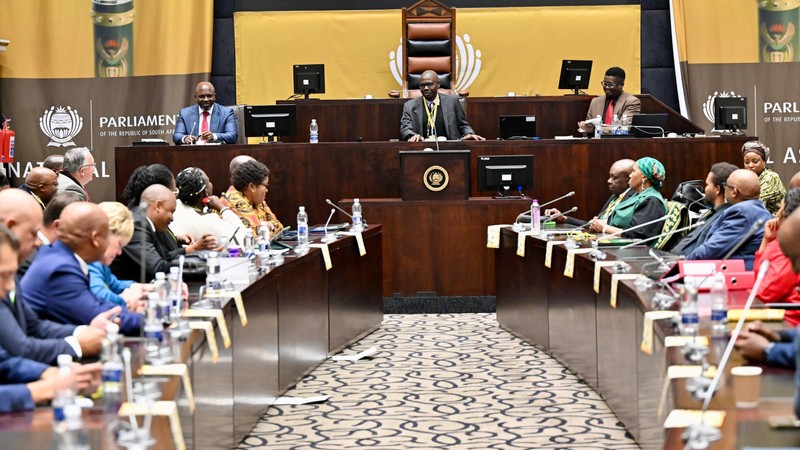
Makashule Gana, Chief Whip of Rise Mzansi, has been elected chairperson of South Africa’s newly formed Impeachment Committee on the Section 89 Enquiry — the body tasked with determining whether President Cyril Ramaphosa should be removed from office over the Phala Phala scandal.
Negotiations over the chairperson position went down to the wire. Just one hour before the committee’s first meeting, African Transformation Movement (ATM) President Vuyo Zungula told the media that several names had been proposed, but some parties were still undecided.
When the vote finally took place, two candidates were put forward: Dr Lehlohonolo Mahlatsi and Makashule Gana. Gana won with 19 votes against Mahlatsi’s 12.
In an unexpected move, the ANC — the ruling party — chose not to nominate its own candidate, Doris Mpapane, and instead backed Gana. He received support from a broad coalition of parties.
Gana explained that Rise Mzansi’s independence from the executive branch made the party a trusted choice to lead such a sensitive process. “Rise Mzansi is not in the executive. The GNU is a political arrangement outside of Parliament,” he said.
He drew a parallel with his party’s role chairing COPA, another oversight body. “The support from the ANC, the DA, the IFP, the PA, and Al Jama-ah is because of the work that one has done,” Gana added.
The committee will first meet through a sub-committee on rules to establish the framework guiding its work. Gana, who is also part of that sub-committee, stressed his commitment to impartiality.
“My mandate is to ensure that the work of the committee proceeds and produces a report that will withstand legal scrutiny,” he said. “Members of Parliament, witnesses, evidence leaders, and counsel for the president must all feel that this process is fair.”
The committee was established following a Constitutional Court ruling that declared Parliament’s 2022 rejection of the original Phala Phala impeachment report unconstitutional. It will now reassess that report from scratch.
The committee includes members from 16 political parties. The ANC holds the largest share with nine seats, followed by the DA with five, the MK Party with three, and the EFF with two.
If the committee finds that Ramaphosa engaged in serious misconduct, it can recommend his removal. That recommendation would then go to the National Assembly, where a two-thirds majority of MPs would be required to remove the president from office.