Physical Address
304 North Cardinal St.
Dorchester Center, MA 02124
Physical Address
304 North Cardinal St.
Dorchester Center, MA 02124

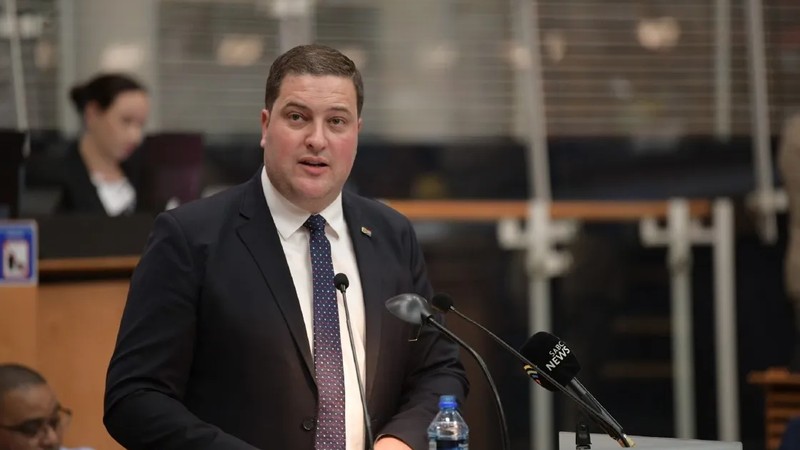
A major political row has erupted within South Africa’s Government of National Unity after reports revealed that 27,797 high-risk parolees have gone missing — and the Department of Correctional Services cannot account for any of them.
Democratic Alliance (DA) leader Geordin Hill-Lewis fired the first shot, calling out Justice and Correctional Services Minister Pieter Groenewald directly on social media platform X.
“Nearly 28,000 parolees are untraceable. Gone. Missing,” Hill-Lewis posted. “Many of these are violent criminals, now walking free, putting the public at risk. Pieter Groenewald must not hide behind excuses.”
The confrontation follows an investigation by amaBhungane, which found that 15,860 of the missing parolees were classified as “archived absconders” — individuals released between 1991 and 2004 whose cases were quietly labelled non-active.
The DA wasted no time escalating the issue. The party formally wrote to Portfolio Committee Chairperson Kgomotso Ramolobeng, demanding an emergency parliamentary meeting. Hill-Lewis wants the committee to summon Minister Groenewald, the National Commissioner of Correctional Services, and senior departmental officials to answer four key questions:
The DA also called for a GPS-enabled electronic monitoring pilot programme to launch within 12 months, with mandatory tracking for all parolees convicted of violent crimes.
Minister Groenewald refused to accept the criticism, accusing Hill-Lewis of playing “cheap politics.” He argued that many of the figures cited date back to 1991 and do not solely reflect recent failures under his watch.
“I am in the process of issuing electronic bracelets for parolees. There is progress. I had a parole summit last September to discuss revisions to the parole system,” Groenewald stated, adding that legislative amendments are already underway.
Hill-Lewis was unmoved. He dismissed the minister’s parole summit as a “talk shop”, pointing out that thousands of dangerous offenders — including convicted murderers and rapists — remain unaccounted for two years into Groenewald’s tenure.
Portfolio Committee Chairperson Kgomotso Ramolobeng acknowledged the severity of the reports. She confirmed the committee would hold an urgent meeting with the department, expressing particular concern over claims that some missing parolees had been convicted of murder, rape, and armed robbery.
The Department of Correctional Services defended its monitoring processes, insisting absconders remain under active investigation and that parolee details are shared with local police stations, traditional councils, and families.
However, the department’s own data tells a troubling story. Over the past two years, 5,760 parolees reoffended during their parole period — a recidivism rate of 10.98%.
South Africa’s prisons are also dangerously overcrowded. The current inmate population stands at 168,795 — including 106,280 sentenced offenders and 62,092 remand detainees — against an approved capacity of just 107,067, placing overcrowding at roughly 58%.
The department further acknowledged that Community Corrections faces serious operational challenges, including budget cuts, staff shortages, security risks in high-crime areas, and growing caseloads — all of which directly impact the ability to track parolees effectively.
The breakdown in parole supervision is not just a political dispute — it is a public safety crisis that hits hardest in the communities where young South Africans live, work, and study.
With tens of thousands of convicted offenders unaccounted for and a prison system stretched well beyond its limits, the pressure on government to deliver real reform — not just summits and promises — has never been greater.