Physical Address
304 North Cardinal St.
Dorchester Center, MA 02124
Physical Address
304 North Cardinal St.
Dorchester Center, MA 02124

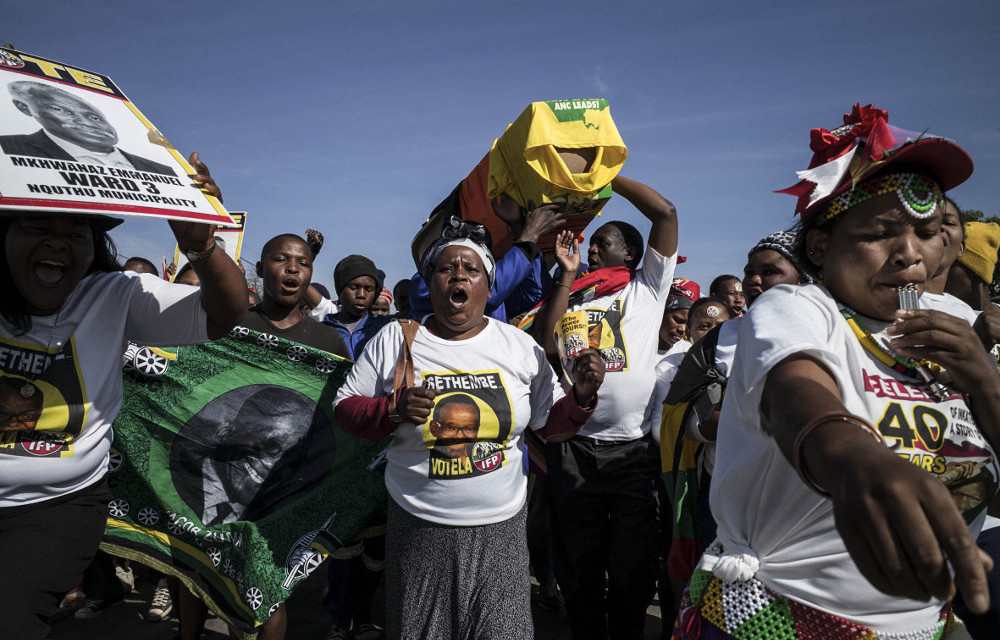
In rural KwaZulu-Natal, the IFP has once again demonstrated its capacity for ground-level dominance—claiming a decisive by-election win that consolidates its grip on the uMfolozi municipality, even as the ANC clawed back ground in Mpumalanga.
The IFP victory in KZN came in Ward 17 of uMfolozi, a rural constituency encompassing the villages of Mningi, Biliya and Magwetshana. Historically contested and politically volatile, this area delivered a resounding endorsement of the Inkatha Freedom Party, as it swept all seven voting districts in the final round of 2025 by-elections.
The IFP won 62% of the vote (up from 51%), trouncing Jacob Zuma’s MK party at 21%, while the ANC collapsed to a mere 16% (down from 42%).
The Bhiliya Primary School district remained the party’s stronghold, where it received a staggering 80% of the vote. Crucially, even in previously contested zones like Mningi High School—where MK had beaten the IFP by 95 votes in 2024—the party eked out a 25-vote win.
This electoral triumph comes mere days after IFP premier Thami Ntuli narrowly survived a motion of no confidence in the provincial legislature, lending symbolic and strategic weight to what could easily be dismissed as a “local” result.
MK, which came within striking distance in the 2024 provincial election, failed to capitalise on its momentum. While it edged ahead of the ANC in four districts, its inability to break the IFP’s organisational machine on the ground raises serious questions about its viability beyond its personality-driven appeal.
The ANC, once a dominant force in uMfolozi, now appears an afterthought. Its former fortress at Mningi High School is now a contested zone. The result reflects a broader rural disenchantment with the party’s fractured leadership and perceived neglect of non-urban constituencies.
In Mpumalanga, however, the script flipped. The ANC pulled off a critical gain in Ward 14 (Harmony Park) in Mkhondo, wresting it from an independent who had stunned the party in 2021.
With 54% of the vote (up from 38%), the ANC bested MK, which came in at 36%. AIMSA, the local breakaway party, trailed at 6%, while the EFF matched its prior performance at 4%—a result that should spark alarm in the red beret ranks.
This ward had gone heavily for MK in 2024, with Zuma’s party scoring 61% to the ANC’s paltry 20%. That the ANC could reverse such a defeat within a year is telling—not just of MK’s limitations in candidate selection and messaging, but also of the ANC’s enduring institutional networks in Mpumalanga.
This was the ANC’s eleventh by-election win in Mkhondo since 2021, capping off a methodical campaign to reclaim lost territory. The ANC has, in this microcosm, proven that while it may be a party in national decline, it retains the capacity to outmanoeuvre insurgents at the ward level.
These by-elections may seem small on paper, but they serve as weather vanes. The IFP victory in KZN is not just a local affirmation—it’s a strategic stabiliser in the wake of recent political turbulence. It confirms the IFP’s rural base remains unshaken, even as Gauteng and the Western Cape move into coalition uncertainty.
Likewise, the ANC’s win in Mkhondo reminds the party’s detractors that, while weakened, it is far from irrelevant—particularly in provinces where it still controls the patronage networks that power the machinery of local politics.
The final round of by-elections for 2025 has now concluded. The next round resumes on 21 January 2026, with the DA defending seats in Tshwane and George—crucial tests for the official opposition ahead of local government elections later that year.